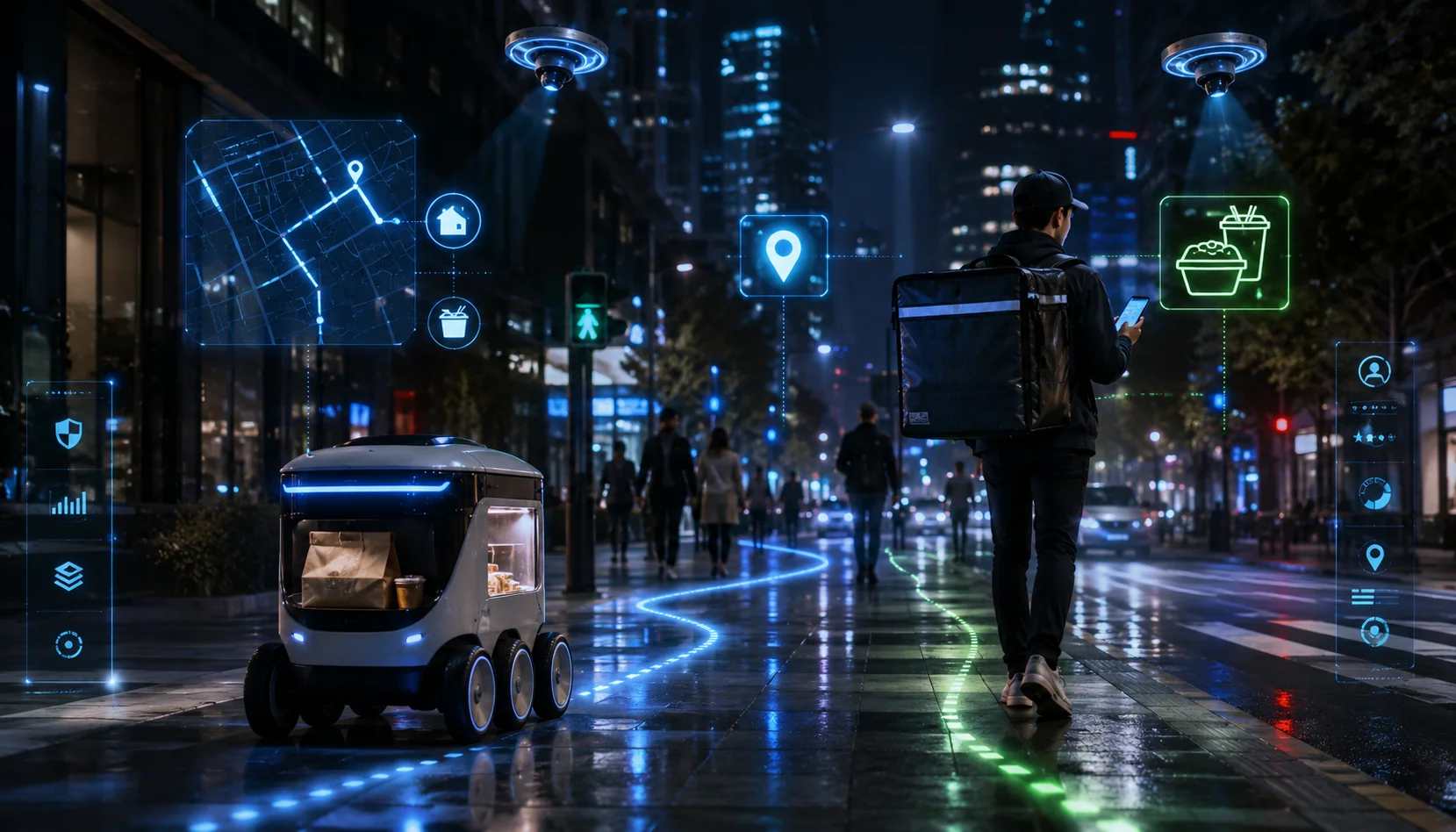
Uber delivery robots are becoming a visible part of the future of food delivery. In some cities, small autonomous robots are already moving along sidewalks, carrying meals and packages to customers. For many people, this raises a serious question: are Uber’s robots set to replace human delivery drivers completely?
The simple answer is no, not yet.
Robots are becoming useful in delivery, but they are not ready to replace human couriers at full scale. Instead, Uber’s delivery future appears to be a hybrid model where robots handle simple, short-distance deliveries while human drivers continue to manage complex routes, difficult buildings, longer distances, and unpredictable customer needs.
This means delivery robots may change the job market, but they are unlikely to remove human delivery workers entirely in the near future.
What Are Uber Delivery Robots?
Uber delivery robots are autonomous or semi-autonomous machines used to deliver food and small items through the Uber Eats platform.
These robots are usually small, electric, and designed to move on sidewalks or in controlled urban areas. They use cameras, sensors, maps, AI navigation, and remote support systems to travel from restaurants to customers.
Uber works with robotics partners rather than building every robot itself. Companies such as Serve Robotics, Avride, Cartken, Nuro, and others have been connected to Uber’s autonomous delivery efforts in different markets. Uber has also described robot delivery as a new addition to the Uber Eats network, working alongside existing couriers in select cities.
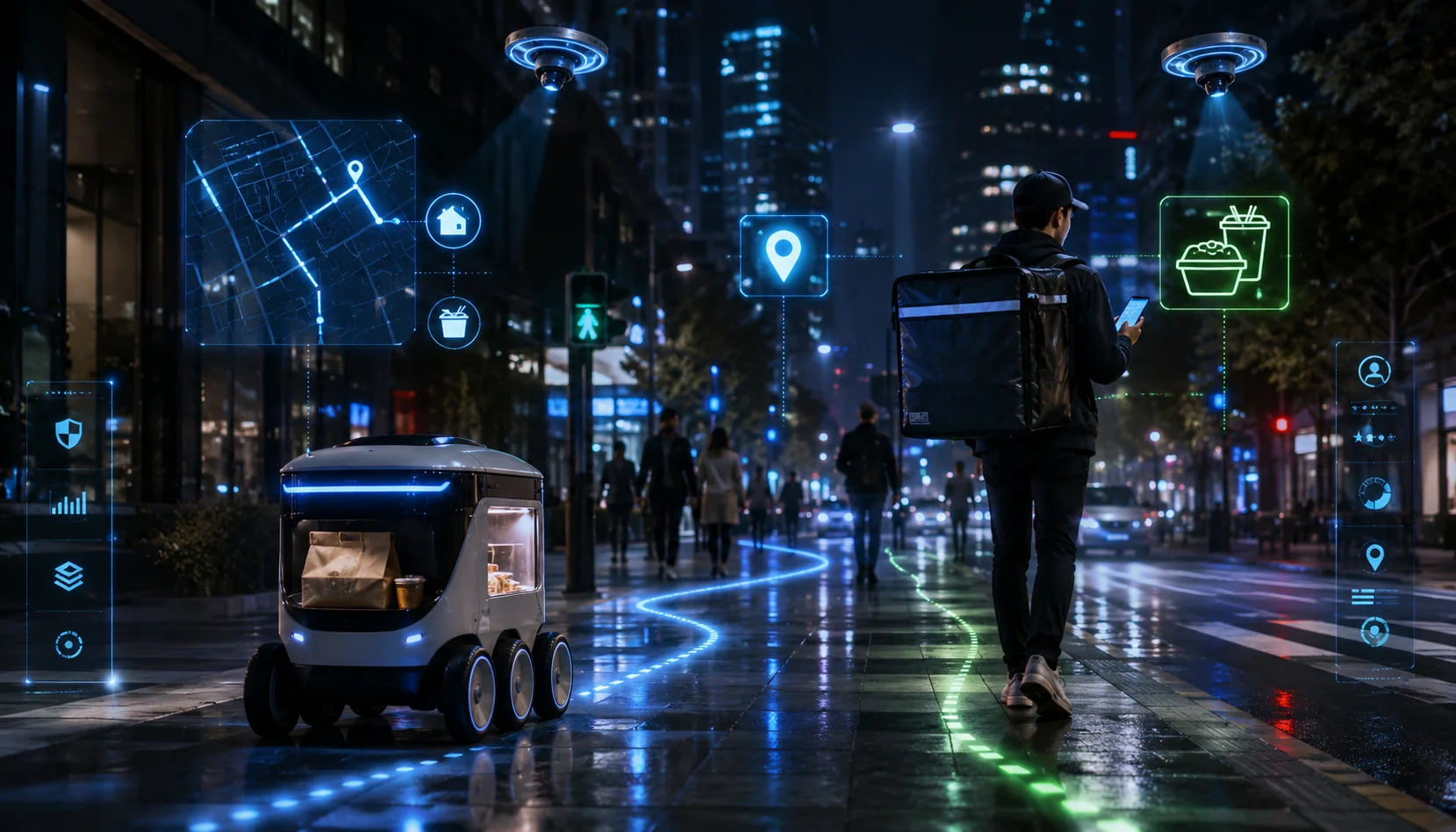
This is important because Uber is not replacing the whole delivery system overnight. It is testing where automation makes the most sense.
Why Uber Is Testing Robot Delivery
Uber is interested in robot delivery because food delivery is a high-volume, low-margin business.
Every delivery involves time, labour, fuel, traffic, parking, routing, and customer communication. If robots can handle some deliveries more efficiently, Uber may reduce costs and improve delivery availability.
Robots also offer several possible advantages.
They do not get tired. They can operate for long hours. They do not require tips. They can follow predictable routes. They may also reduce the need for short car trips in dense areas.
As a result, robots are attractive for short-distance food delivery, especially in places where restaurants, customers, and sidewalks are close together.
Where Delivery Robots Work Best
Delivery robots perform best in structured environments.
They are most useful in areas with smooth sidewalks, predictable pedestrian movement, low-speed traffic, short delivery distances, and clear routes. This is why college campuses, planned communities, downtown zones, and selected neighbourhoods are common testing grounds.
For example, autonomous delivery companies often focus on places where orders are frequent and distances are short. Avride has described college campuses as ideal environments because they are compact and have high delivery density.
In these settings, robots can solve the “last-mile” or even “last 500 metres” problem. They can move food from a restaurant to a nearby customer without needing a car, scooter, or bike.
Therefore, robots are useful when the route is simple and the environment is predictable.
Where Human Delivery Drivers Still Win
Human delivery drivers remain far more adaptable than robots.
A human courier can climb stairs, enter apartment buildings, speak with security guards, call customers, follow unusual instructions, carry heavier orders, handle substitutions, and respond to unexpected problems.
For example, if a customer says, “Please leave the order at the back gate, call me when you arrive, and avoid the dog near the entrance,” a human can understand and adjust quickly.
A robot may struggle with that level of complexity.
Humans can also handle bad weather, road closures, broken elevators, confusing addresses, crowded sidewalks, and last-minute customer changes better than robots.
This is why robots may help with simple deliveries but still depend on humans for difficult ones.
Weather Is a Major Challenge
Weather is one of the biggest barriers to full robotic delivery.
Rain, snow, extreme heat, flooding, mud, ice, and poor visibility can reduce robot performance. Sidewalk robots may struggle with puddles, slippery surfaces, blocked paths, and uneven ground.
Human couriers also face weather challenges, but they can make judgement calls. They can choose alternative routes, carry umbrellas, protect food, or contact the customer.
Robots need more testing and stronger hardware before they can operate reliably in all weather conditions.
Because of this, delivery robots are more realistic in certain climates and controlled areas than in every city.
City Infrastructure Is Not Robot-Ready
Most cities were not designed for delivery robots.
Broken sidewalks, blocked pavements, curb cuts, construction zones, parked scooters, street vendors, crowds, stairs, potholes, and unpredictable pedestrians can create serious problems.
A robot may be technically advanced, but public space is messy.
In addition, cities need rules for where robots can travel, how fast they can move, how they share space with pedestrians, and who is responsible if something goes wrong.
Without supportive infrastructure and clear regulations, large-scale robot delivery will be difficult.
Safety and Public Acceptance Matter
Delivery robots must operate safely around people.
They share sidewalks with children, people using wheelchairs, pets, cyclists, and busy crowds. Even if the robots move slowly, people still need to trust them.
Public acceptance is also a challenge.
In some cities, delivery robots have faced vandalism or negative reactions. For example, reports from Philadelphia described incidents where Uber Eats delivery robots were kicked, sat on, or toppled shortly after launch.
This shows that robot delivery is not only a technology issue. It is also a social issue.
If people see robots as annoying, unsafe, or job-threatening, adoption may slow down.
The Economic Reality of Delivery Robots
On paper, delivery robots look attractive.
Once deployed, they may reduce labour costs, support high-volume delivery zones, and operate for long hours. However, robots are not free.
They require expensive hardware, maintenance, charging, mapping, software updates, remote monitoring, insurance, customer support, and city approvals.
In other words, robot delivery still depends on a hidden support system.
A robot may look autonomous on the sidewalk, but behind it there may be engineers, remote operators, maintenance teams, fleet managers, and customer support staff.
This is one reason full replacement is unlikely in the short term.
Robots May Reconfigure Work Instead of Replacing It
Delivery robots may not eliminate human labour. Instead, they may change what kind of labour is needed.
A recent academic paper on delivery robots argues that public-facing robots often depend on human support, regulatory coordination, and social cooperation. In other words, robot labour is not fully independent; it is part of a larger human-technology system.
This means some delivery jobs may decline in robot-friendly zones, but new roles may grow in robot monitoring, repair, fleet operations, mapping, dispatch, and customer support.
Therefore, the future is not simply “robots versus humans.” It is more likely to be humans managing, supporting, and working alongside robots. Unsupervised Robotaxi Service: The Future of Autonomous Mobility
Uber’s Hybrid Delivery Strategy
Uber’s current strategy appears to be hybrid rather than full replacement.
Robots can handle short, predictable, low-complexity deliveries. Human couriers can handle longer trips, difficult drop-offs, apartment buildings, customer communication, and unpredictable conditions.
This hybrid model gives Uber flexibility.
If a delivery is simple and nearby, a robot may be assigned. If the delivery is complex or outside the robot’s service area, a human courier can take it.
This approach allows Uber to test automation without depending on robots for every order.
Will Robots Reduce Delivery Jobs?
Delivery robots could reduce some delivery opportunities in certain areas.
If robots become common in college campuses, downtown zones, and short-distance food corridors, fewer human couriers may be needed for those specific trips.
However, full job replacement is unlikely soon because most deliveries still require human flexibility.
Delivery work is not only about moving an item from point A to point B. It also involves problem-solving, communication, judgement, and navigating messy real-world environments.
Robots can automate part of the delivery chain, but not the entire delivery experience.
What Customers Can Expect
Customers may start seeing more robot delivery options in selected areas.
A robot delivery experience may involve ordering through the Uber Eats app, receiving a notification when the robot arrives, walking outside to meet it, and unlocking the storage compartment through the app.
This can be convenient for customers in apartments, campuses, offices, and dense neighbourhoods.
However, it may not work for everyone.
Some customers may prefer human handoff. Others may not want to walk outside. People in high-rise buildings or gated communities may still need human couriers.
Therefore, robot delivery will likely become an option, not the only method.
What Human Drivers Should Expect
Human delivery drivers should expect gradual change, not instant replacement.
Robots may take over some short-distance, low-tip, repetitive deliveries in certain markets. However, human drivers will remain important for complex orders and areas where robots cannot operate well.
Drivers may also see platform changes as Uber optimises which orders go to robots and which go to humans.
This could affect earnings in some zones. However, it may also reduce inefficient short trips and allow drivers to focus on higher-value deliveries.
The real impact will depend on city rules, robot costs, customer demand, and how Uber designs its dispatch system.
The Future of Uber Delivery Robots
The future of Uber delivery robots will likely grow city by city.
Robot delivery will expand first in places with supportive regulations, good sidewalks, strong order density, low vandalism risk, and predictable delivery patterns.
Over time, robots may become more capable. Better batteries, improved sensors, stronger AI navigation, remote assistance, and smarter mapping could make them more reliable.
However, scaling will still take time.
Even by 2026, robot delivery remains an experiment in many places, not a complete replacement for human couriers.
Conclusion
Uber delivery robots are not ready to replace human delivery drivers completely.
They are useful for short, predictable, low-complexity deliveries in controlled environments. They can reduce some costs, improve efficiency, and support contactless delivery.
However, human couriers still outperform robots in complex real-world situations. They can handle stairs, locked buildings, bad weather, customer communication, unusual instructions, and unpredictable city conditions.
The future of delivery is likely to be hybrid.
Robots will handle some simple tasks, while humans will continue to manage the deliveries that require adaptability, judgement, and personal interaction.
So, are Uber’s robots set to replace human delivery drivers completely?
Not yet. They are more likely to change delivery work than erase it.