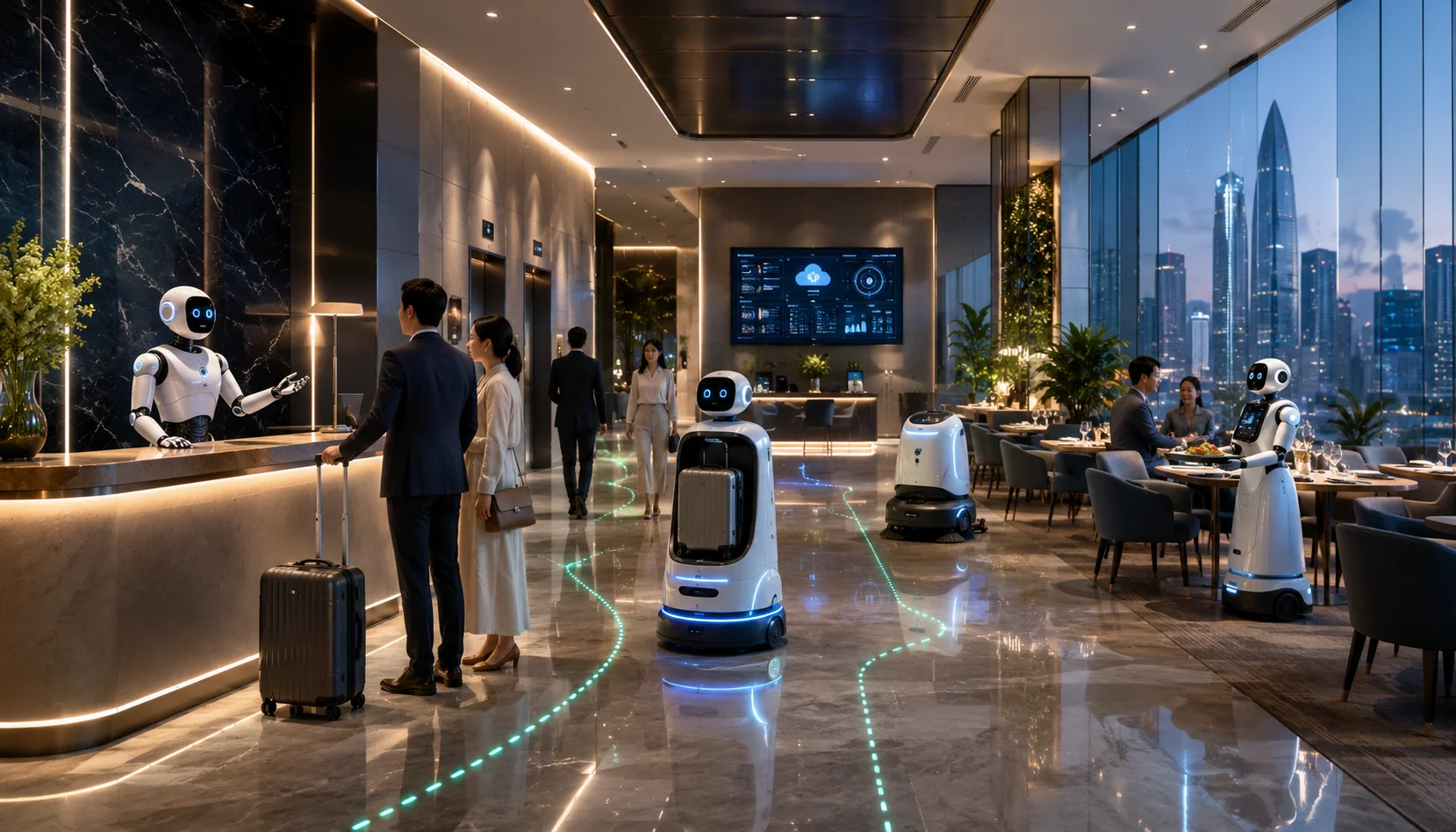
Pudu Robotics robot hotel project in Shenzhen is becoming one of the most interesting developments in hospitality automation. Hotels have used service robots before, but this project aims to go much further.
Instead of using robots for only one or two tasks, Pudu Robotics and Shenzhen Culture & Tourism Industry Development are working on what they describe as the world’s first full-scenario robot-serviced hotel.
The project is planned for the West Artificial Island of the Shenzhen-Zhongshan Link in China. If fully delivered, it could show how hotels may operate in the future, with robots supporting guest reception, room delivery, cleaning, food service, and daily guest assistance.
This does not mean hotels will suddenly remove humans completely. However, it does show that hospitality automation is moving from isolated robot tools to fully connected service ecosystems.
What Is the Pudu Robotics Robot Hotel?
The Pudu Robotics robot hotel is a planned hotel project where robots support multiple service areas across the guest experience.
In many hotels today, robots may deliver towels, bring food to rooms, clean floors, or guide guests in the lobby. However, these robots often work as separate tools.
The Pudu Robotics robot hotel aims to create a more integrated model.
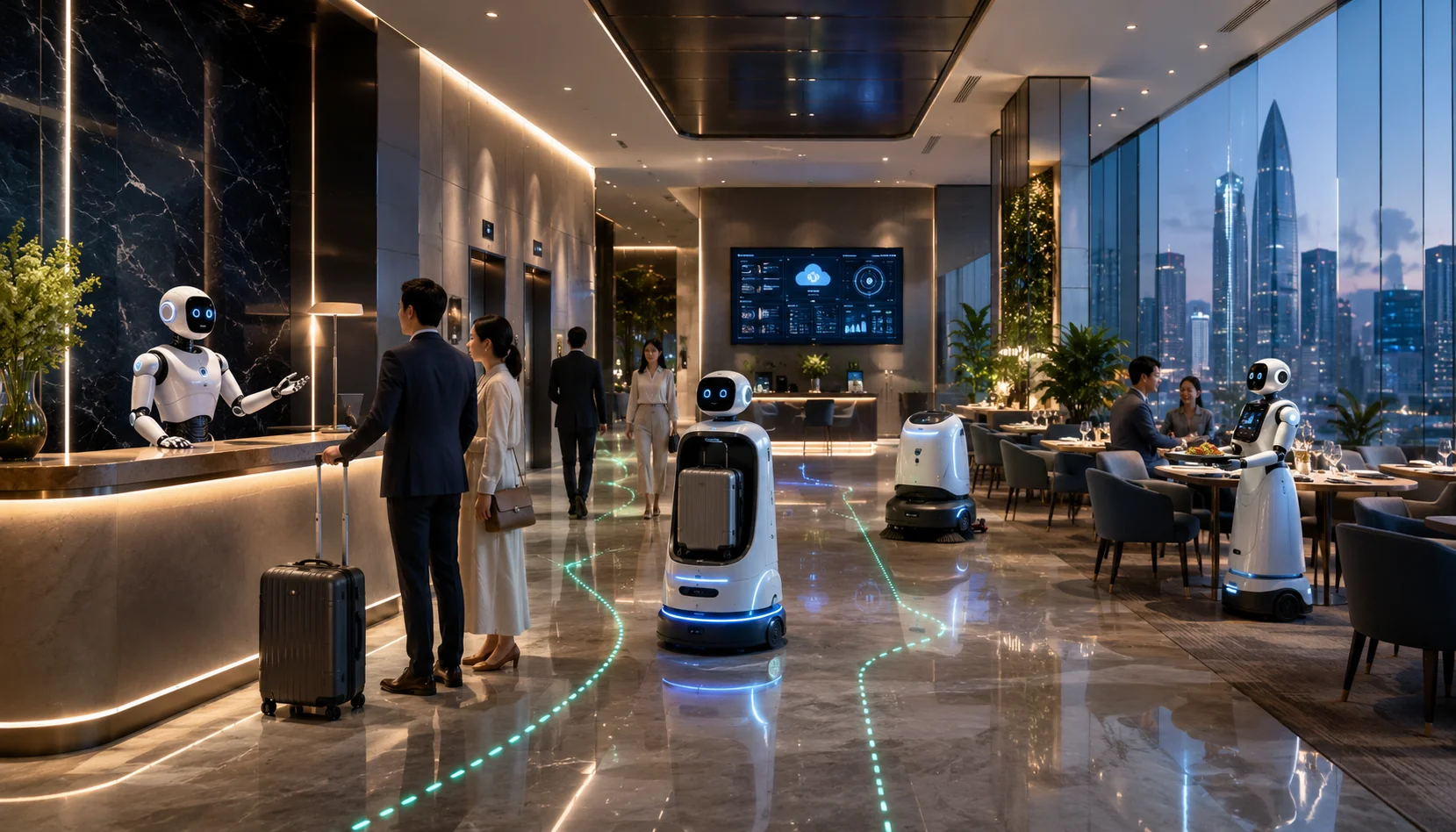
That means different robots could work together inside one hotel environment. For example, one robot may greet guests, another may deliver luggage or room items, another may clean public areas, and another may support restaurant operations.
As a result, the hotel could become a real-world example of multi-robot collaboration in hospitality.
Why This Project Matters
The Pudu Robotics robot hotel matters because the hospitality industry is under pressure to become faster, smarter, and more efficient.
Hotels face rising labour costs, staff shortages, high guest expectations, and the need for consistent service quality. At the same time, travellers increasingly expect digital convenience, fast response times, and contactless service options.
Robots can help solve some of these problems.
AI Isn’t Intelligent : It’s Advanced Pattern Matching
They can handle repetitive tasks, reduce staff workload, operate for long hours, and provide consistent service. Therefore, hotel employees can focus more on human-centred roles such as guest relations, problem-solving, personal service, and hospitality management.
This is why robot hotels are no longer just a futuristic idea. They are becoming a serious business strategy.
A New Era of Hospitality Automation
Hospitality automation has been growing for years.
Hotels already use online booking systems, mobile check-in, digital room keys, smart elevators, automated payment systems, and AI-powered customer service chatbots.
Service robots are the next step.
In the past, hotel robots were often used for limited tasks. For example, a robot might deliver water bottles or guide guests to a meeting room. These use cases were useful, but they did not transform the entire hotel operation.
The Pudu Robotics robot hotel could change that by connecting multiple robotic services into one coordinated system.
This is why the project is being described as “full-scenario.” It is not only about one robot in the lobby. It is about robots working across many hotel scenarios.
What Services Could Robots Handle?
A full-scenario robot-serviced hotel could include several automated services.
Robot Reception
Robots may welcome guests, provide basic information, answer common questions, guide visitors, and support check-in processes.
This could reduce waiting time at the front desk and improve service speed during busy hours.
Room Delivery
Delivery robots can bring towels, toiletries, food, drinks, documents, and other guest items directly to rooms.
These robots can use elevators, navigate corridors, avoid obstacles, and notify guests when they arrive.
Cleaning and Housekeeping Support
Cleaning robots can help maintain lobbies, corridors, meeting rooms, restaurants, and other public spaces.
They can sweep, scrub, vacuum, mop, and report cleaning status. As a result, housekeeping teams can focus on more detailed tasks that still require human attention.
Food Service
Restaurant robots can help serve food, transport dishes, clear tables, and support dining operations.
This can improve restaurant efficiency, especially during peak meal times.
Guest Support
Robots can provide directions, answer basic questions, guide visitors to facilities, and support concierge-style services.
However, more complex or emotional guest needs will still require human staff.
Multi-Robot Collaboration Is the Key
The most important part of the Pudu Robotics robot hotel is not simply the presence of robots. It is the coordination between them.
A hotel is a complex environment. Guests move between rooms, restaurants, lobbies, elevators, meeting halls, and outdoor spaces. Staff must coordinate cleaning, deliveries, check-ins, maintenance, and food service.
For robots to work well in this environment, they need smart scheduling, navigation, elevator integration, obstacle avoidance, and task coordination.
This is where embodied AI and multi-robot collaboration become important.
If different robots can communicate, share tasks, and work safely around people, automation becomes more useful. Instead of replacing one task, robots can support the entire hotel workflow.
Why Shenzhen Is an Important Location
Shenzhen is one of China’s most advanced technology cities. It is known for robotics, electronics, manufacturing, startups, and smart-city development.
Launching a robot-serviced hotel project in Shenzhen makes sense because the city already has a strong innovation ecosystem.
The planned location on the West Artificial Island of the Shenzhen-Zhongshan Link also adds significance. The Shenzhen-Zhongshan Link is one of the major infrastructure projects in the Guangdong-Hong Kong-Macao Greater Bay Area, and the west artificial island has been positioned as a tourism and technology landmark.
Therefore, the project combines hospitality, robotics, tourism, and smart infrastructure in one destination.
How Robots Could Improve Guest Experience
Hotel robots can improve guest experience in several ways.
First, they can provide faster service. A guest who requests bottled water, towels, or snacks may receive them quickly without waiting for available staff.
Second, robots can reduce repetitive interactions. Guests who prefer contactless service may appreciate automated delivery or digital support.
Third, robots can improve consistency. Unlike human staff, robots do not get tired during repetitive delivery or cleaning tasks.
Fourth, robots can create novelty. Many guests may find a robot-serviced hotel interesting, especially in a technology-focused destination like Shenzhen.
However, guest experience depends on good design. Robots must be helpful, easy to use, quiet, safe, and reliable. If they create confusion or delays, guests may become frustrated.
How Robots Could Help Hotel Staff
A common concern is that robots may replace hotel workers. However, the more realistic short-term impact is task redistribution.
Robots are best suited for repetitive, time-consuming, and physically demanding tasks. These may include moving items, cleaning large floor areas, transporting dishes, or guiding guests through standard routes.
Human staff are still better at empathy, judgement, conflict resolution, personal service, cultural understanding, and handling unusual situations.
Therefore, robots can help staff by reducing workload and allowing employees to focus on higher-value guest services.
In this model, robots do not remove hospitality. They support it.
The Business Case for Robot Hotels
Hotel operators are interested in automation because it can improve efficiency and reduce operational pressure.
A robot-serviced hotel may help with:
- Lower repetitive labour workload
- Faster guest response times
- Better cleaning consistency
- Improved delivery efficiency
- Reduced service bottlenecks
- More contactless service options
- Stronger brand differentiation
- Better operational data collection
In competitive tourism markets, a robot hotel can also become a marketing advantage.
Guests may choose the hotel not only for accommodation but also for the experience of staying in a future-focused automated environment.
Challenges Facing Robot Hotels
Although the Pudu Robotics robot hotel project is exciting, challenges remain.
Robots must operate safely around guests, children, luggage, furniture, elevators, and crowded spaces. They must also handle unexpected situations such as blocked corridors, spills, power issues, network failures, or confused guests.
Hotels also need strong digital infrastructure. Robots require stable Wi-Fi, maps, charging stations, management software, elevator integration, cybersecurity controls, and technical support.
In addition, guests may have different comfort levels. Some people may enjoy robotic service, while others may prefer human interaction.
Therefore, successful robot hotels must balance automation with human hospitality.
Cybersecurity and Data Privacy Concerns
Robot hotels also raise cybersecurity and data privacy questions.
Service robots may collect operational data, navigation data, images, voice inputs, room delivery records, and guest interaction data. If this data is not protected properly, privacy risks could arise.
Hotels must secure robot systems, networks, guest information, and cloud platforms. They must also be transparent about what data robots collect and how that data is used.
As hotels become smarter, cybersecurity becomes part of hospitality quality.
A robot hotel must be safe not only physically but also digitally.
Will Robot Hotels Replace Human Hotels?
Robot hotels are unlikely to replace traditional hotels completely.
Many guests still value human warmth, personal service, cultural hospitality, and emotional connection. Luxury hospitality especially depends on personalised human care.
However, robot hotels may become more common in certain areas.
They may work well in business hotels, airport hotels, smart tourism zones, high-volume city hotels, and technology-themed destinations.
The future is likely to be hybrid.
Humans and robots will work together, with robots handling repetitive tasks and humans focusing on guest experience.
What This Means for the Hospitality Industry
The Pudu Robotics robot hotel project shows where hospitality may be heading.
Hotels are becoming more digital, automated, and data-driven. Operators want smoother service, lower friction, and better efficiency. Guests want speed, convenience, cleanliness, and personalisation.
Robots can support these goals if they are deployed carefully.
This means hotel managers may need new skills in robotics operations, automation planning, data security, guest experience design, and technical maintenance.
Hospitality workers may also need training to collaborate with robots instead of seeing them only as competition.
The Future of Hospitality Automation
Hospitality automation will likely continue growing over the next decade.
We may see more hotels using robots for delivery, cleaning, greeting, luggage transport, security patrols, and facility management. In addition, AI systems may help manage bookings, pricing, guest requests, maintenance, and energy use.
The Pudu Robotics robot hotel could become an important test case.
If the project succeeds, other hotels may copy parts of the model. If it struggles, the industry will still learn valuable lessons about where robots work best and where human service remains essential.
Either way, the project pushes hospitality automation forward.
Conclusion
Pudu Robotics robot hotel project in Shenzhen represents a major step toward the future of hospitality automation.
By planning a full-scenario robot-serviced hotel, Pudu Robotics and Shenzhen CTID are showing how robots could support reception, room delivery, cleaning, food service, and guest assistance in one integrated environment.
The project does not mean human hospitality is disappearing. Instead, it suggests a future where robots handle repetitive operational tasks while human staff focus on personalised service and complex guest needs.
The opportunity is significant, but the challenges are also real. Safety, reliability, privacy, guest comfort, cybersecurity, and cost will all determine whether robot hotels become mainstream.
For now, the Pudu Robotics robot hotel is more than a technology showcase. It is a sign that the hospitality industry is entering a new era where automation, AI, and human service will increasingly work together.