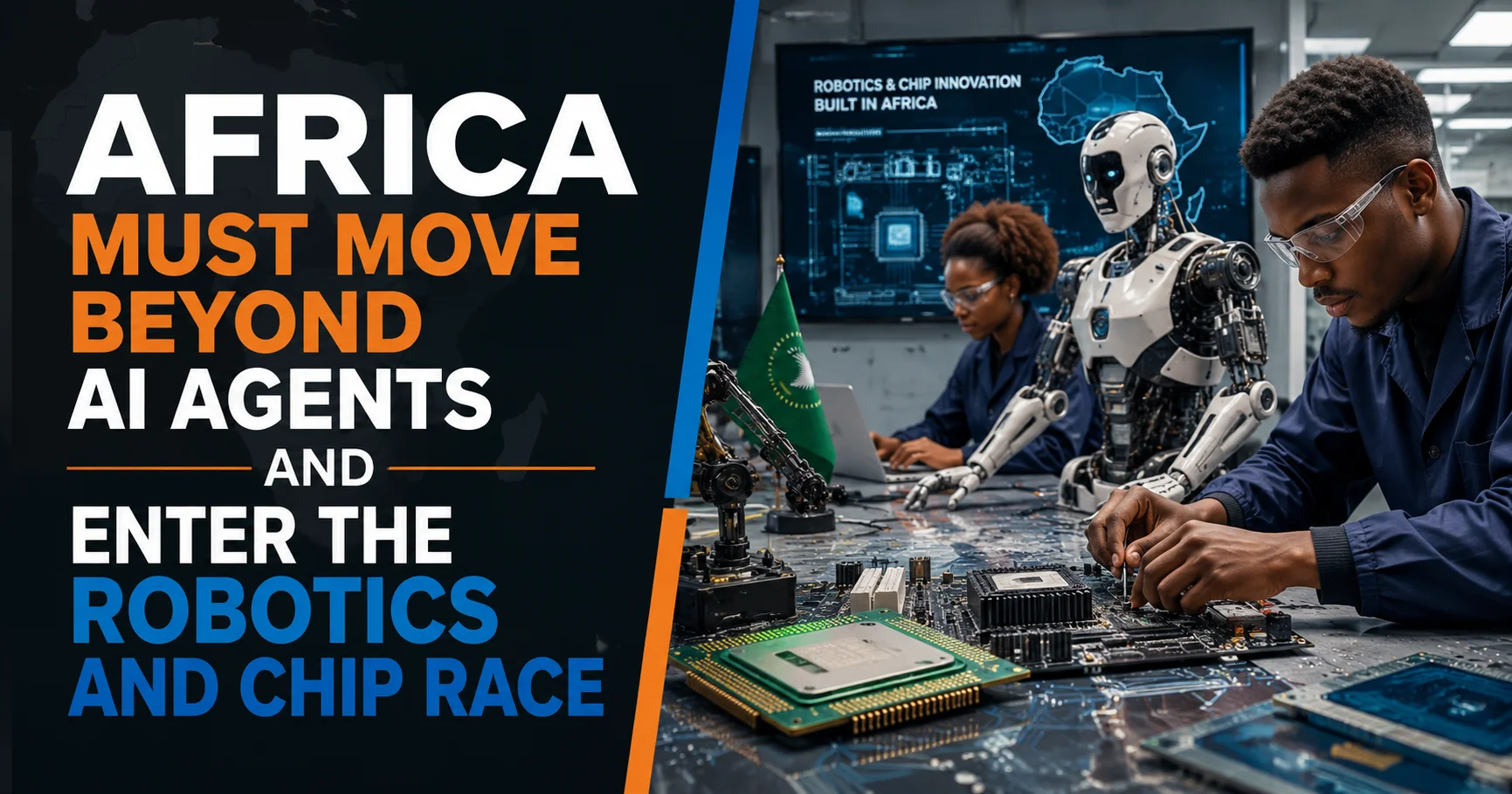
Africa’s AI conversation has largely focused on chatbots, large language models, and AI agents, tools that are improving finance, healthcare, education, and agriculture. That progress matters, but the global AI race is entering a new phase: physical AI, the convergence of AI, robotics, computer vision, sensors, and autonomous systems.
The next contest is not just about who builds the smartest chatbot. It is about who builds machines that can see, move, and act in the real world, and who controls the chips that power them. Africa cannot afford to sit this phase out.
Why Robotics Matters for Africa
Africa has real world problems that robotics can address directly.
Agriculture: Autonomous tractors, crop monitoring drones, and robotic harvesters could transform productivity in a sector that is still heavily dependent on manual labor.
Mining: Autonomous vehicles and inspection robots can improve safety and productivity in hazardous environments, particularly given Africa’s enormous mineral wealth.
Healthcare: Robotics can support laboratory automation, medical logistics, and remote healthcare delivery.
Infrastructure: Intelligent machines can inspect and maintain roads, power grids, pipelines, and water systems.
The opportunity is not necessarily about building humanoid robots. It is about building robots that solve African problems.
The Bigger Race: AI Chips
Every intelligent machine needs computing power, making semiconductors a critical part of the next phase of AI development. Global spending on semiconductor manufacturing equipment is projected to reach roughly $133 billion in 2026 and $151 billion in 2027.
Africa does not need to compete directly with companies such as NVIDIA or TSMC. Instead, African countries can build strategic positions across parts of the semiconductor value chain, including chip design, embedded systems, sensors, packaging, testing, and specialized AI accelerators.
The World Economic Forum has highlighted the potential for African countries to integrate into global semiconductor supply chains through regional specialization, rather than attempting to replicate established semiconductor hubs such as Taiwan or Shenzhen.
From Consumer to Owner
Africa’s technology growth has often followed a familiar pattern: import technology, deploy it, and build applications on top of it. This approach has created significant success in areas such as fintech and e commerce, but it also leaves Africa dependent on foreign infrastructure and intellectual property.
Owning AI models, robotics platforms, chips, and hardware, rather than simply building applications on top of foreign technology, is where Africa can capture greater economic value.
What It Will Take
Africa needs an industrial strategy that connects universities, governments, investors, technology companies, and manufacturers.
Education must also change. African universities and technical institutions need to teach students not only how to use AI, but also how chips are designed, how machines are controlled, how sensors work, and how computer vision systems are developed.
Regional specialization could also provide a realistic path forward. Different countries could build on their existing strengths:
South Africa: Industrial and engineering capacity
Kenya: Technology and innovation ecosystem
Nigeria: Market size and technical talent
Egypt: Engineering and manufacturing
Rwanda: Innovation and technology hub positioning
Working together, these capabilities could form the foundation of a genuine African technology supply chain.
Practical Over Flashy
Even advanced humanoid robots still face significant challenges when performing reliable industrial tasks. Africa should therefore focus less on the spectacle and more on practical applications.
A crop harvesting robot, a pipeline inspection drone, or an autonomous mine safety system could deliver far more immediate value than a humanoid robot demonstration.
The same principle applies to semiconductors. Africa does not need to begin by chasing the most advanced 2 nanometer manufacturing processes. It could start with specialized processors and embedded systems designed for agriculture, telecommunications, energy, transportation, and the Internet of Things.
The Talent Bottleneck
None of this will happen without engineers.
Africa needs more specialists in semiconductor engineering, robotics, embedded systems, artificial intelligence, computer vision, electronics, and advanced manufacturing.
This means education must shift from simply teaching people how to use AI tools to teaching them how AI systems and the hardware behind them actually work.
The continent needs engineers who can design circuit boards, develop sensors, program robots, build computer vision systems, design chips, and integrate hardware with intelligent software.
The Goal: Designed in Africa
The ambition should move beyond assembly toward technology that is designed, engineered, and manufactured in Africa.
Imagine agricultural robots built specifically for African farms. Imagine processors designed for African telecommunications networks. Imagine computer vision systems trained and optimized for African environments. Imagine African companies supplying components to the global robotics and semiconductor industries.
That is how technology adoption can evolve into genuine industrialization.
The Window Is Now
Global investment is pouring into AI infrastructure, robotics, semiconductors, and autonomous systems. Companies such as NVIDIA are increasingly positioning physical AI and autonomous machines as major areas of growth. Africa faces a choice. It can remain primarily a consumer of the infrastructure being built elsewhere, or it can begin building and owning a meaningful part of the next technology economy.
The question should no longer be:
“How can Africa use AI?”
The question should be:
“What part of the AI economy can Africa build and own?”
The future is not just AI that talks. It is AI that sees, moves, operates, and builds.
And underneath it all are the chips.