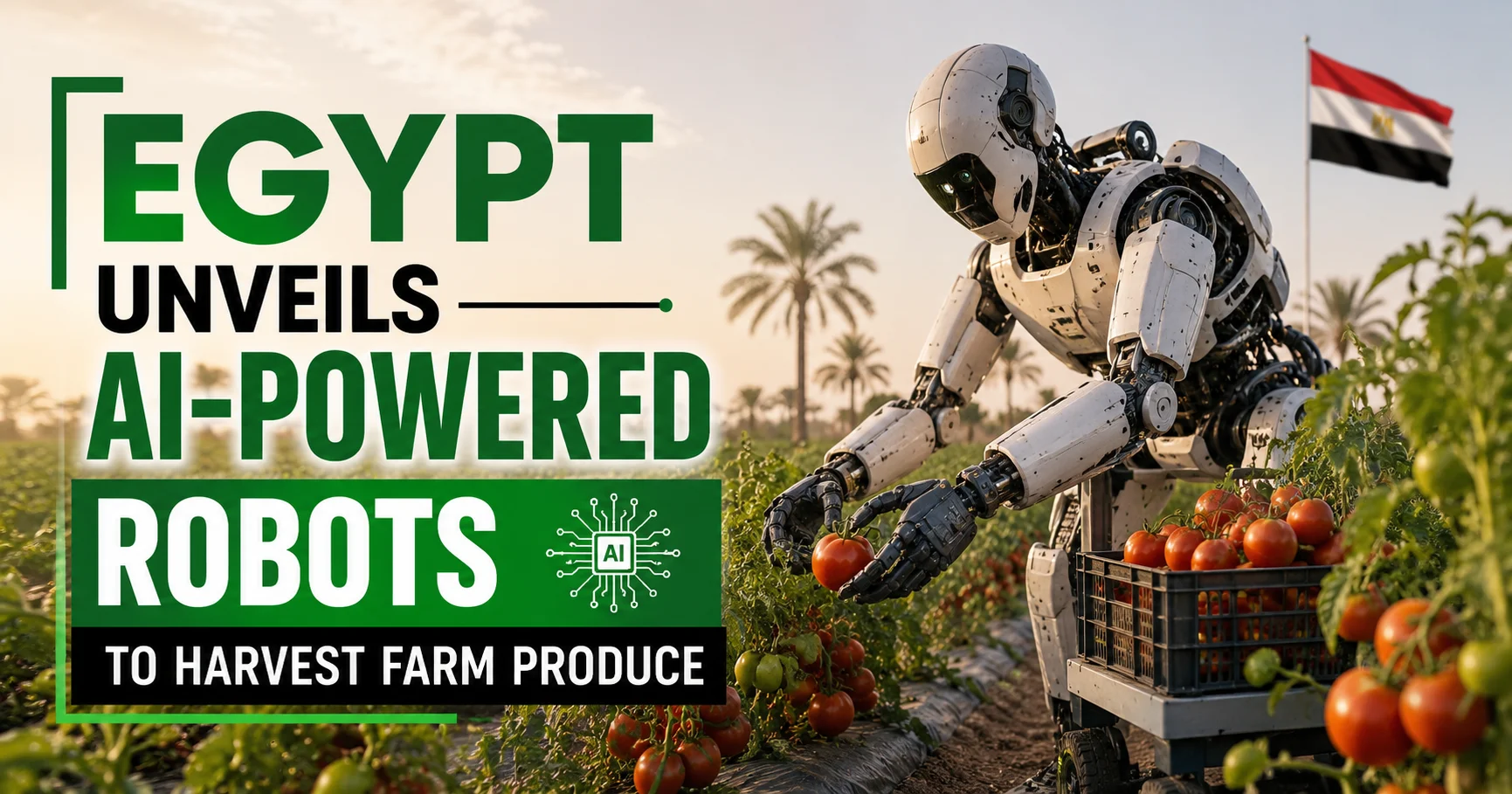
Egypt is making significant progress in agricultural robotics with the unveiling of an autonomous harvesting robot developed by Egyptian engineers. Built by the Egyptian deep-tech company Egrobots, the machine combines artificial intelligence, computer vision, and autonomous navigation to identify crops, move through farmland, and assist with harvesting while reducing the need for continuous human intervention.
The robot was unveiled on May 10, 2026. Egrobots describes it as the first autonomous agricultural harvesting robot developed entirely by Egyptian engineers in Egypt and the wider Arab world. Founded in 2023 by Akhlad Alabhar and Amr Saleh, Egrobots focuses on physical AI, autonomous systems, and robotics.
Who Designed the Robot?
Egrobot’s harvesting system was designed and developed by its Egyptian engineering team. The company says its team has more than 50 years of combined experience in robotics and industrial systems.
Co-founder and CEO Akhlad Alabhar studied computer engineering and control systems at Alexandria University. His technical background has contributed to the company’s focus on combining artificial intelligence with physical robotic systems.
Egrobots is also part of the Google for Startups program and NVIDIA Inception, connecting the company with international technology and AI ecosystems.
How Far Along Is the Technology?
Egrobots has progressed beyond the initial concept stage, demonstrating autonomous navigation and testing its robotic systems in agricultural environments.
However, the company has not publicly confirmed a date for the robot’s first full-scale harvesting field trial. This is an important distinction because operating in real agricultural environments presents challenges that are difficult to reproduce in controlled settings.
Uneven terrain, changing weather conditions, different crop sizes, and unpredictable plant positions can all affect the performance of an autonomous harvesting system.
How Advanced Is the Robot?
The harvesting system combines several technologies. Computer vision allows the robot to identify crops, while artificial intelligence helps it determine how to move through the field. Autonomous navigation enables the machine to operate with limited human intervention.
The system can be configured with up to four robotic arms working simultaneously. According to Egrobots, it can harvest approximately 160 kilograms per hour and operate continuously, including overnight.
If these capabilities can be maintained consistently under real farm conditions, the technology could help address some of the challenges facing agricultural producers, including labor shortages, seasonal demand for workers, and rising operating costs.
What Comes Next?
The next major step for Egrobots is moving from technological demonstrations to reliable commercial deployment.
Agricultural robotics must prove that it can work consistently in different crops, farms, weather conditions, and terrains while remaining affordable for farmers. Achieving that balance will be critical to determining whether the technology can move beyond demonstrations and become a practical agricultural solution.
Egrobot’s ambitions also extend beyond agriculture. The company has developed a traffic-management robot with Egypt’s Ministry of Interior and is working on humanoid robots and industrial automation technologies.
If its harvesting technology can be deployed economically at scale, Egypt could strengthen its position as an emerging hub for robotics and physical AI in Africa and the Middle East. The development also highlights a broader shift in Africa’s technology sector, as local engineers increasingly move from adopting imported AI technologies to developing sophisticated robotic systems designed for real-world applications.
Egypt’s agricultural robot may still be at an early stage of commercial development, but its emergence demonstrates the growing potential of Africa’s robotics industry and the ability of local engineering talent to build advanced machines for industries that directly affect the continent’s economy.