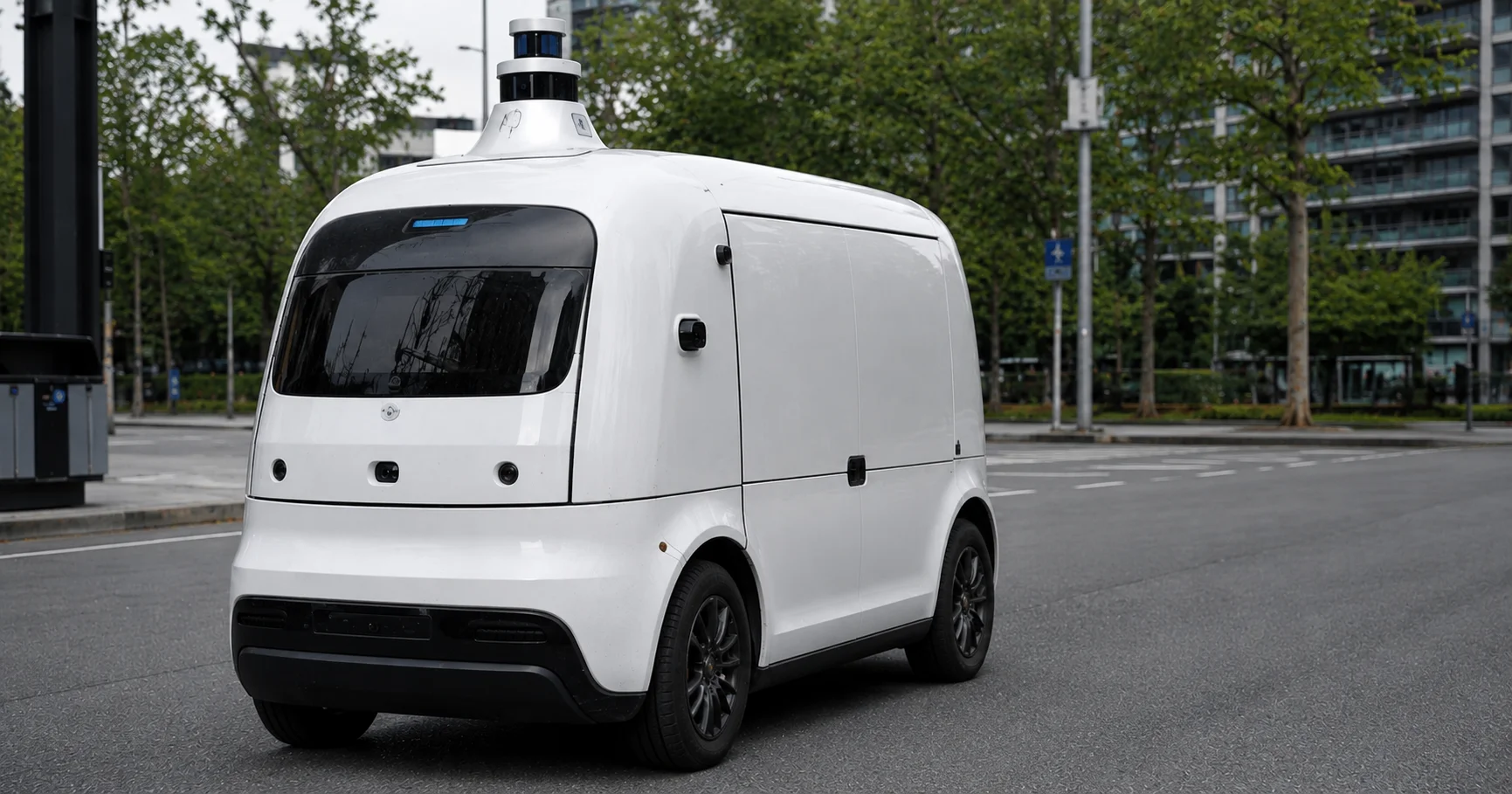
A video circulating online appears to show an autonomous delivery vehicle in China leaving the roadway and coming to rest in a roadside ditch. The footage has attracted significant attention and raised an important question: how can a vehicle equipped with cameras, radar, and automated driving systems fail to identify an obvious roadside hazard?
The exact technical cause of the incident has not been publicly confirmed. However, the event provides a useful case study of the engineering challenges that remain in developing reliable autonomous vehicles for real world environments.
Possible Causes
Although the definitive cause has not been established, several technical factors could potentially contribute to an incident of this type.
1. Perception Failure
Autonomous vehicles rely on cameras, radar, LiDAR, and other sensors to understand their surroundings. If the vehicle failed to accurately detect the ditch, road boundary, or sudden change in terrain, its perception system may have incorrectly interpreted the area as part of the drivable road.
Environmental conditions can also affect sensor performance. Poor lighting, unusual road surfaces, obstructions, weather conditions, or unexpected changes in the environment can make it more difficult for an autonomous system to accurately interpret its surroundings.
2. Mapping or Localization Error
Autonomous vehicles often use detailed maps and precise positioning systems to determine their location and plan routes. If the actual road environment differs significantly from the information available to the vehicle, the navigation system may make decisions based on inaccurate or outdated information.
Construction, road damage, temporary barriers, and changes to road boundaries can create situations where the physical environment no longer matches the vehicle’s expected route.
3. Path Planning Failure
Recognizing a potential hazard is only one part of autonomous driving. The vehicle must also determine what action to take.
If the system did not correctly classify the ditch as a hazard, the planning system could have continued following its intended route. A robust system should be capable of slowing down, stopping, or selecting an alternative path when the environment does not provide sufficient confidence for continued movement.
Why This Is a Difficult Engineering Problem
Human drivers do more than identify vehicles, pedestrians, traffic signs, and traffic lights. They continuously interpret the broader driving environment, including potholes, damaged roads, construction zones, uneven surfaces, temporary obstacles, roadside barriers, and other unexpected conditions.
For an autonomous vehicle, these situations must be detected, classified, and translated into appropriate driving decisions.
An unmarked ditch, sudden change in road elevation, or poorly defined road boundary can present a particularly difficult situation because it may not fit neatly into the categories used by the vehicle’s perception and planning systems.
This is one of the major challenges facing autonomous vehicle development. A system may perform extremely well under normal conditions while still encountering difficulties when presented with unusual situations that were not adequately represented during testing.
The Path Forward
The incident highlights an important lesson for the autonomous vehicle industry: real world driving environments are considerably more complex and unpredictable than controlled testing environments.
Companies developing autonomous delivery vehicles will need to continue investing in extensive testing across different road conditions, weather environments, lighting conditions, construction zones, and unexpected hazards.
Equally important are fail safe mechanisms that allow the vehicle to slow down or stop when the system is uncertain about the environment. In situations where the vehicle cannot confidently determine whether a path is safe, stopping may be preferable to continuing along a planned route.
Continuous monitoring, improved sensor integration, better environmental understanding, stronger localization systems, and extensive real world testing will also be essential for improving reliability.
Conclusion
Autonomous driving technology has made significant progress, but incidents such as this demonstrate that reliable operation in unpredictable environments remains a major engineering challenge.
The objective is not simply to build a vehicle that can drive itself under normal conditions. The greater challenge is developing a system that can recognize when conditions fall outside its expectations, respond appropriately, and stop safely when necessary.
Ultimately, reliability will be one of the most important factors determining whether autonomous delivery vehicles can operate safely and effectively on a scale. The ability to handle unexpected situations may prove just as important as the ability to navigate ordinary roads successfully.