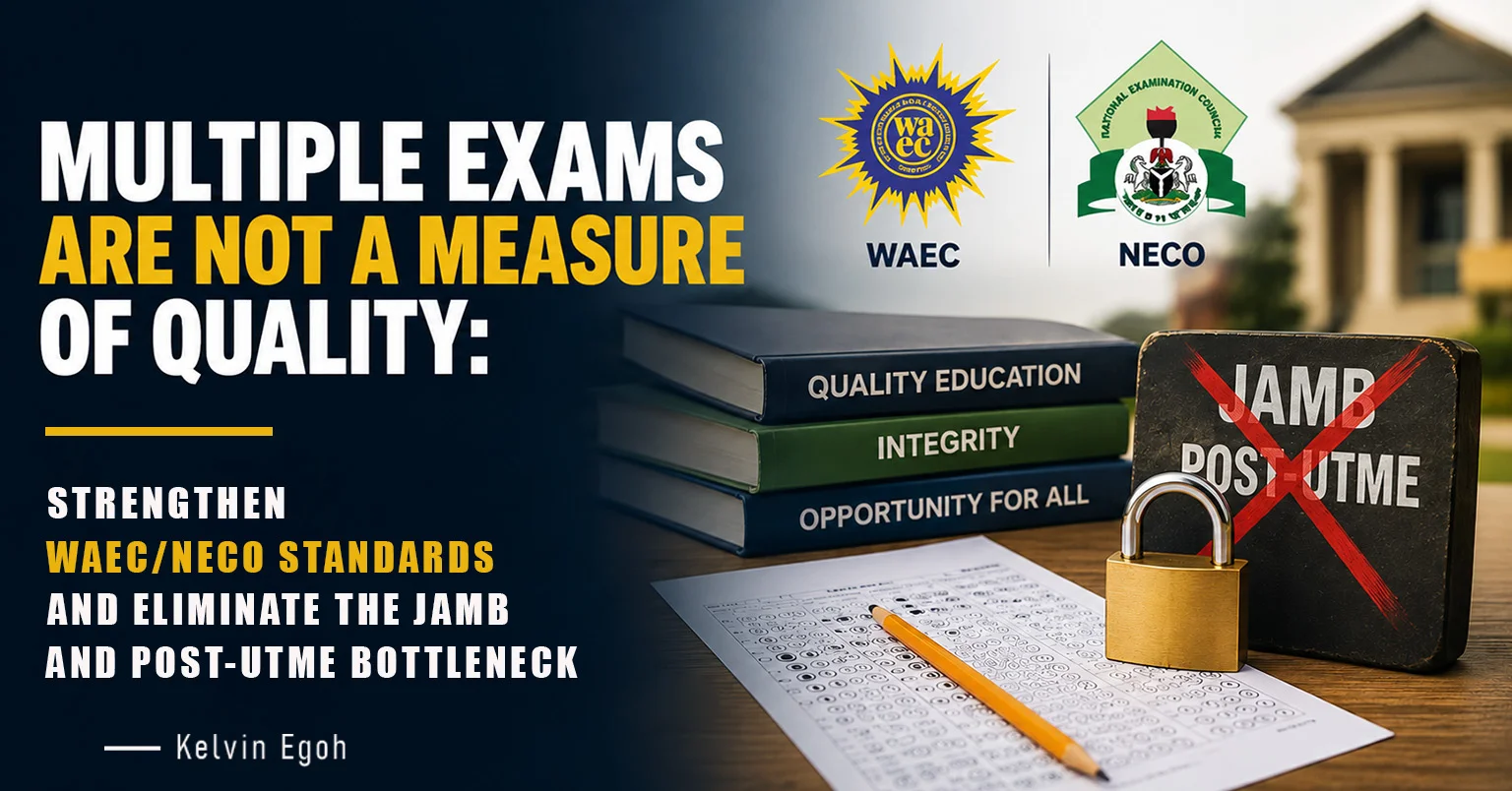
Every year, millions of Nigerian students complete secondary school with one goal: gaining admission into a university. Yet, for many, the journey involves writing WAEC or NECO, sitting for JAMB’s Unified Tertiary Matriculation Examination (UTME), and then taking a post-UTME screening conducted by their chosen university. Even after successfully passing all three, admission is far from guaranteed.
This raises an important question: does requiring multiple entrance examinations actually produce better graduates? After decades of relying on this system, there is little evidence that it has improved the quality of university education. Instead, it has created unnecessary financial burdens, prolonged the admission process, and forced many qualified students to spend years retaking examinations. The system often rewards persistence rather than academic ability, while the deeper challenges facing Nigeria’s universities remain unresolved.
Nigeria does not need more admission hurdles. It needs to strengthen and trust its existing secondary school examination system while focusing on what truly determines graduate quality: well-funded, well equipped, and properly managed universities that provide students with a world class education.
A Journey That Shouldn’t Take Years
In many countries, the path to university is straightforward: students complete secondary school, sit a nationally recognized examination, apply to universities, and gain admission if they meet the required grades.
In Nigeria, however, the journey is far more complicated. A typical student must navigate a long series of hurdles:
- WAEC or NECO examinations
- JAMB’s Unified Tertiary Matriculation Examination (UTME)
- Post-UTME screening conducted by individual universities
- Lengthy admission waiting lists
- Supplementary admission rounds
- In many cases, an additional year of waiting before trying again
For many students, this process extends university admission by one or even two years after completing secondary school. Even students with excellent WAEC or NECO results are often denied admission not because they lack ability, but because they miss a UTME cut-off score, fail a post-UTME screening, or are affected by admission quotas. Academic merit alone is no longer enough; students must also overcome a complex and unpredictable admission process.
Key Reforms to Strengthen WAEC/NECO and Remove the JAMB/Post-UTME Bottleneck
If Nigeria invests in making WAEC and NECO more secure, transparent, and technologically advanced, there will be little justification for maintaining separate UTME and Post-UTME examinations. A stronger secondary school examination system can provide a fairer, more efficient, and less expensive pathway into higher education while allowing universities to focus on improving the quality of teaching, research, and graduate outcomes rather than repeatedly testing students.
1. Strengthen Examination Integrity
WAEC and NECO must adopt stronger security measures to eliminate examination malpractice. This should include biometric candidate verification, AI-assisted monitoring, secure digital transmission of examination materials, and tougher penalties for individuals and institutions involved in cheating. A more credible examination system will inspire greater confidence among universities and employers.
2. Modernize Assessment and Result Processing
Both examination bodies should gradually transition to computer-based testing where appropriate, supported by digital marking, standardized grading, and faster result processing. Modern assessment methods will improve accuracy, reduce human error, and ensure that students are evaluated more fairly and efficiently.
3. Improve School Accountability and Quality Assurance
Government regulators should strengthen the accreditation and monitoring of secondary schools. Continuous assessment scores should be independently audited, while schools found engaging in examination malpractice or grade inflation should face strict sanctions. This will ensure that school-based assessments remain credible.
4. Replace JAMB with a Transparent National Admission Platform
Rather than requiring students to sit another entrance examination, Nigeria should establish a centralized admission system that uses verified WAEC/NECO results alongside each university’s published admission requirements. This would simplify the admission process, reduce costs for families, and eliminate unnecessary duplication of examinations.
5. Enhance the Credibility and Verification of WAEC/NECO Results
WAEC and NECO should introduce secure digital certificates, comprehensive performance reports, and a nationwide electronic verification system that universities can easily access. Strengthening the credibility and accessibility of examination records will make these certificates sufficient for university admissions without the need for additional screening examinations.
More Exams Haven’t Made Better Universities
The common argument for maintaining this multi-layered admission process is that it helps protect academic standards. Yet Nigerian universities continue to struggle with overcrowded lecture halls, outdated curricula, chronic underfunding, inadequate laboratory facilities, and a shortage of qualified lecturers. Academic calendars are frequently disrupted, and many institutions have not meaningfully upgraded their teaching and research infrastructure in years.
If multiple layers of examinations truly guaranteed quality, Nigerian universities would rank among the best in the world. Instead, many graduates leave university without the practical knowledge and skills required by today’s job market. Gaining admission is difficult, but the quality of education students receive after admission often falls short of expectations. That disconnect is the clearest evidence that the current admission system is addressing the wrong problem.
The Real Problem Is Capacity, Not Examinations
Nigeria has one of the largest youth populations in Africa, and every year millions of young people compete for limited university admission spaces. The demand for higher education has grown far faster than the country’s ability to provide quality opportunities for students.
Instead of addressing this shortage by expanding capacity, the system has increasingly relied on tougher examinations and stricter admission requirements to control access to the few available spaces. These exams do not solve the real problem; they only determine who gets access to a system that is already overwhelmed.
The challenge is not that Nigerian students are unqualified or that they need more hurdles to prove themselves. The real bottleneck is the lack of enough quality universities, qualified lecturers, modern facilities, and well-funded academic programs. No examination, no matter how difficult, can create more classrooms, laboratories, or learning opportunities.
The solution is long-term investment: expanding universities, improving funding, recruiting and training more lecturers, upgrading infrastructure, and creating stronger vocational and digital education pathways. Nigeria does not need more barriers for students; it needs a larger, stronger, and more inclusive education system that can meet the demands of its growing population.
How Other Countries Handle This
Many countries struggle to provide enough university places for all qualified students. However, Nigeria is one of the few countries where students must pass several entrance exams before they can gain admission.
In Ghana, students use their WASSCE results, administered by WAEC, to apply for university. Each university sets its own admission requirements, and students who meet them are admitted without taking another national entrance exam.
In the United Kingdom, students are admitted based on A-Levels, Scottish Highers, or equivalent qualifications. Some competitive courses may also require interviews or aptitude tests, but there is no single national entrance exam for every university applicant.
In the United States, universities consider several factors, including high school grades, the courses a student completed, personal essays, recommendation letters, and extracurricular activities. Some universities also require or accept standardized tests, while many do not.
Although these countries have different admission systems, they share one important principle: secondary school qualifications are trusted as the main basis for university admission. Additional assessments are used only for programs that genuinely require them, such as medicine, law, architecture, or the arts, rather than for every applicant.
Strengthen WAEC and NECO Instead of Duplicating Them
Nigeria already has nationally recognized secondary-school exams. Rather than stacking JAMB and Post-UTME on top of them, policymakers should focus on making WAEC and NECO more trustworthy: tighter exam security, less malpractice, better question design that rewards analytical thinking, stronger continuous assessment, better-trained examiners, and clearer grading.
If those exams carry public confidence, universities can admit students based on them directly, keeping extra screening for the small number of programs where it’s genuinely warranted rather than treating it as a default second exam for everyone.
CONCLUSION
None of Nigeria’s education problems get solved by asking students to pass more tests. They get solved by strong schools, competent teachers, well-resourced universities, and sustained investment. WAEC and NECO already exist and already work reasonably well. The task now is to trust them, and to redirect the energy currently spent on duplicate testing toward building universities worth getting into.
An education system isn’t judged by how many exams its students survive but judged by what they know, what they can do, and who they become. Nigeria’s future depends on better education, not more examinations.