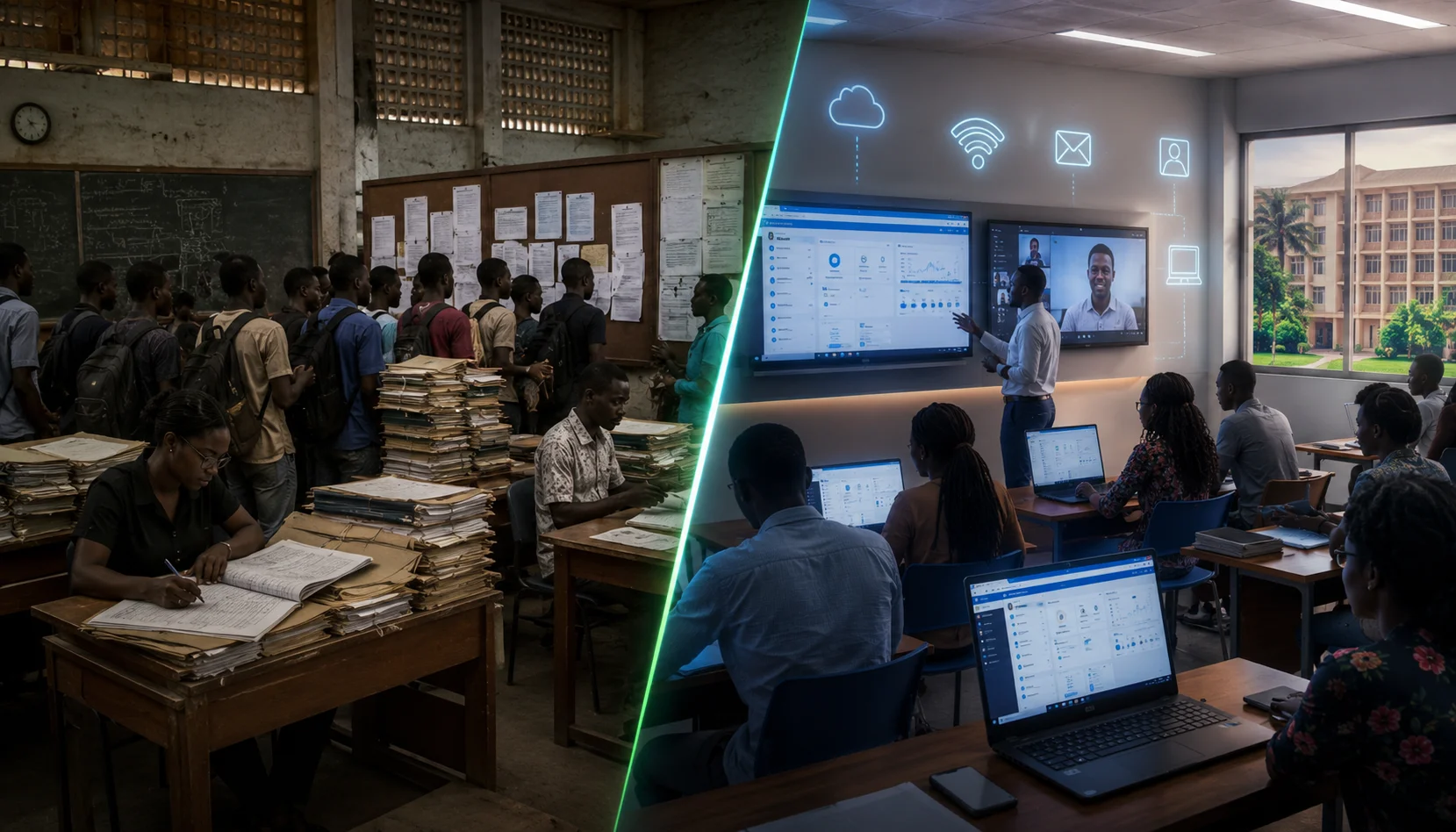
Digital decay in Nigerian universities is becoming one of the biggest challenges facing higher education in the country. Around the world, universities are using technology to improve teaching, learning, research, communication, and student services. However, many state and federal universities in Nigeria are still struggling to keep up.
In modern academic systems, students can attend hybrid lectures, access recorded classes, submit assignments through learning management systems, receive updates through institutional emails, and manage their academic records through student portals.
However, in many Nigerian universities, students still depend heavily on physical lectures, printed handouts, notice boards, manual registration, and slow administrative processes.
This gap is no longer a small inconvenience. It is a serious educational problem.
If Nigerian universities do not urgently improve their digital infrastructure, students may graduate with degrees but without the digital confidence needed for today’s global workforce.
What Is Digital Decay in Nigerian Universities?
Digital decay in Nigerian universities refers to the slow decline, absence, or poor use of educational technology in higher institutions.
It does not always mean that technology is completely missing. In many cases, some digital systems exist, but they are outdated, poorly maintained, underused, or not properly integrated into academic life.
This digital decay can be seen in many areas, such as:
- Poor student portals
- Lack of institutional email addresses
- Limited learning management systems
- No lecture recording systems
- Weak online course registration
- Manual result processing
- Poor campus internet access
- Outdated ICT labs
- Lack of smart classrooms
- Limited digital research support
As a result, students and lecturers are forced to work in a system that does not fully support modern education.
Why Educational Technology Matters
Educational technology is no longer optional. It is now a major part of quality education.
Technology helps universities deliver learning more efficiently. It allows students to access materials anytime, communicate with lecturers, submit assignments online, attend virtual classes, and use digital academic resources.
For lecturers, technology can improve teaching, simplify grading, support research, and make communication easier.
For administrators, digital systems can reduce paperwork, speed up student services, improve record keeping, and reduce errors.
Therefore, when universities fail to adopt proper educational technology, the entire academic system suffers.Nigeria Internet Infrastructure Crisis: Why Africa’s Most Populous Nation Still Struggles With Digital Connectivity
The Problem of Manual Academic Processes
One of the clearest signs of digital decay in Nigerian universities is the continued use of manual academic processes.
In many institutions, students still need to visit departments, offices, banks, or notice boards for basic academic tasks. Course registration, result checking, fee confirmation, clearance, and timetable access may still involve unnecessary physical movement and paperwork.
This creates stress for students and increases delays.
In a fully digital university system, students should be able to access most academic services online. They should not need to stand in long queues or depend on informal updates from classmates before getting important information.
Manual processes also increase the risk of missing records, human error, corruption, and poor communication.
Weak or Outdated Student Portals
A student portal should be the digital centre of university life.
A good student portal allows students to register courses, pay fees, check results, view timetables, download academic documents, receive announcements, and communicate with the institution.
However, many Nigerian universities either lack strong student portals or operate portals that are slow, outdated, unreliable, or poorly designed.
Some portals only work during registration periods. Others crash when too many students try to log in. In some cases, students still need to complete offline steps even after using the portal.
This defeats the purpose of digital transformation.
A student portal should not be treated as a seasonal tool. It should be a reliable academic platform that supports students throughout their university journey.
Lack of Institutional Email for Students
Another major issue is the lack of proper institutional email systems.
In modern universities, students usually receive official school email addresses. These emails are used for academic communication, access to digital learning platforms, software licenses, cloud storage, research tools, and global collaboration services.
However, many Nigerian universities do not provide active institutional emails to all students. In some schools, the system exists but is not enforced. In others, students receive email addresses that are rarely used or poorly supported.
This is a major weakness.
An institutional email is more than a communication tool. It is a digital academic identity.
Without it, students may struggle to access educational software, research platforms, online learning services, and professional academic opportunities.
Poor Use of Learning Management Systems
A learning management system, also known as an LMS, helps universities manage online learning.
Through an LMS, lecturers can upload course materials, share lecture notes, collect assignments, grade submissions, hold discussions, and provide feedback. Students can also access learning resources anytime.
Unfortunately, many Nigerian universities do not fully use learning management systems.
Even where an LMS exists, some lecturers may not upload materials regularly. Some students may not be trained to use it. In some institutions, the platform may be slow, outdated, or poorly maintained.
As a result, learning remains tied to physical classrooms.
This limits flexibility and affects students who miss classes because of illness, transport problems, financial challenges, or personal emergencies.
No Lecture Recording or Digital Archives
Many universities across the world now record lectures and make them available to students. This allows students to revise difficult topics, catch up on missed classes, and learn at their own pace.
However, lecture recording is still rare in many Nigerian state and federal universities.
In most cases, once a lecture is missed, the student must depend on classmates’ notes or personal explanations. There is often no official recording, digital archive, or online replay system.
This creates an unequal learning environment.
Students who learn better by revisiting lectures are disadvantaged. Students who work part-time, travel long distances, or face health challenges may also struggle.
Lecture capture should not be seen as luxury technology. It is now a basic part of modern education.
Smart Classrooms Are Still Limited
Smart classrooms use digital tools to improve teaching and learning. These may include projectors, interactive boards, internet-connected screens, digital attendance systems, online collaboration tools, and lecture capture equipment.
However, many classrooms in Nigerian universities still look almost the same as they did decades ago.
Chalkboards, overcrowded lecture halls, printed handouts, and poor sound systems remain common in many institutions.
This affects teaching quality and student engagement.
Today’s students are already familiar with smartphones, videos, apps, and digital content. A classroom that ignores digital interaction may fail to hold their attention or support deeper learning.
Smart classrooms can make lectures more visual, practical, interactive, and effective.
Poor Internet Access on Campus
Reliable internet access is essential for digital education.
Students need internet access for research, assignments, online classes, academic platforms, digital libraries, and communication. Lecturers also need internet connectivity for teaching, research, publication, and collaboration.
However, internet access remains weak in many Nigerian universities.
Some campuses have limited Wi-Fi coverage. Others have internet only in selected offices or ICT centres. In many cases, students rely on personal mobile data, which can be expensive and unreliable.
This creates inequality.
Students who can afford data enjoy better access to online resources, while those who cannot are left behind.
A modern university should provide reliable campus-wide internet access as part of its academic infrastructure.
How Digital Decay Affects Students
Digital decay in Nigerian universities affects students in many ways.
First, it reduces learning flexibility. Students are forced to depend mainly on physical lectures, even when digital tools could support better access.
Second, it limits research quality. Without strong digital resources, students may struggle to access current academic materials, journals, and online databases.
Third, it weakens digital skills. Students may graduate without enough exposure to the tools used in modern workplaces.
Fourth, it increases stress. Manual registration, offline clearance, poor portals, and weak communication create unnecessary frustration.
Finally, it affects global competitiveness. Nigerian graduates must compete with students from institutions where digital tools are fully integrated into learning.
How Digital Decay Affects Lecturers
Lecturers are also affected by weak digital systems.
Without proper educational technology, lecturers may spend more time on manual tasks such as collecting assignments, recording attendance, processing scores, and responding to repeated student questions.
Digital platforms can make teaching easier. They can help lecturers share materials, track student progress, receive assignments, grade work, and communicate more effectively.
In addition, strong digital systems can support academic research and global collaboration.
When lecturers lack digital support, teaching becomes more stressful and less efficient.
Why Nigerian Universities Are Falling Behind
The problem is not caused by one factor. Several issues contribute to digital decay in Nigerian universities.
Underfunding
Many universities struggle with limited budgets. As a result, ICT infrastructure may not receive enough funding.
Poor Digital Strategy
Some institutions buy technology without a clear long-term plan. Without strategy, systems become abandoned or poorly used.
Weak Maintenance Culture
Digital platforms require regular updates, technical support, cybersecurity protection, and user training. Without maintenance, systems quickly become outdated.
Lack of Staff Training
Lecturers and administrative staff need training to use digital tools effectively. Technology will fail if people are not prepared to use it.
Poor Policy Implementation
Even when digital policies exist, enforcement may be weak. For example, a university may create email accounts but fail to make them compulsory for communication.
Leadership Priorities
Digital transformation requires strong leadership. If university management does not prioritise educational technology, progress will remain slow.
The Employability Problem
One of the biggest consequences of digital decay in Nigerian universities is its effect on employability.
Today’s job market requires digital literacy. Employers expect graduates to understand online collaboration tools, professional email communication, digital research, data handling, virtual meetings, cloud platforms, and workplace software.
If students spend years in a low-tech academic environment, they may enter the job market at a disadvantage.
A graduate may be academically intelligent but digitally underprepared.
This can affect confidence, productivity, and job opportunities.
Universities must prepare students not only to pass exams but also to succeed in modern workplaces.
The Digital Gap Between Nigerian Students and Global Peers
Students in more digitally advanced universities often have access to recorded lectures, online libraries, academic software, research databases, virtual labs, and digital collaboration platforms.
Meanwhile, many Nigerian students still struggle with basic digital access.
This creates a global academic gap.
When Nigerian students compete for international scholarships, remote jobs, global internships, or postgraduate opportunities, digital exposure can make a difference.
The issue is not talent. Nigerian students are talented and hardworking. However, they need better systems to support their growth.
How Nigerian Universities Can Fix Digital Decay
Digital decay can be reversed, but it requires serious commitment.
Universities must move beyond temporary ICT projects and build sustainable digital ecosystems.
1. Build Reliable Student Portals
Every university should have a fast, secure, mobile-friendly student portal.
The portal should support course registration, fee payment, result checking, timetable access, announcements, document requests, and academic records.
It should work throughout the year, not only during registration periods.
2. Make Institutional Email Compulsory
Every student and staff member should receive an official university email address.
All formal academic communication should happen through institutional email. This will improve professionalism, digital identity, and access to academic tools.
3. Adopt Learning Management Systems
Universities should use learning management systems for course materials, assignments, quizzes, discussion forums, lecture notes, and feedback.
Students and lecturers should receive proper training to use the platform effectively.
4. Introduce Lecture Recording Systems
Lecture recording should become part of modern teaching.
Even if universities cannot start with every classroom, they can begin with large lecture halls and high-demand courses.
Recorded lectures can help students revise and catch up when they miss classes.
5. Invest in Smart Classrooms
Universities should gradually upgrade classrooms with projectors, interactive screens, reliable audio systems, internet access, and digital teaching tools.
This will improve student engagement and teaching quality.
6. Provide Campus-Wide Internet Access
Reliable internet access should be treated as basic academic infrastructure.
Universities should work with telecom companies, government agencies, and private partners to provide affordable and stable internet access across campuses.
7. Train Lecturers and Staff
Digital transformation will fail without training.
Lecturers, administrators, and ICT teams must receive regular training on educational technology, cybersecurity, online teaching, and digital communication.
8. Strengthen ICT Governance
Universities need strong ICT departments with clear responsibilities, budgets, policies, and accountability.
Digital systems must be maintained, secured, monitored, and improved continuously.
9. Partner With Technology Companies
Universities can partner with technology companies to access cloud platforms, software licenses, digital tools, cybersecurity support, and training programmes.
These partnerships can reduce costs and speed up transformation.
10. Make Digital Skills Part of Every Course
Digital literacy should not be limited to computer science students.
Every student, regardless of department, should learn basic digital skills, online research, professional communication, data handling, and workplace technology.
The Role of Government
Government has a major role to play in solving digital decay in Nigerian universities.
State and federal governments should provide targeted funding for educational technology. They should also support national digital learning policies, broadband access for campuses, ICT training, and accountability systems.
Funding should not only focus on buildings and physical infrastructure. Digital infrastructure is now just as important.
A university without strong digital systems cannot fully prepare students for the modern world.
The Future of Nigerian Higher Education
The future of Nigerian higher education depends on digital transformation.
Students need flexible learning. Lecturers need efficient teaching tools. Administrators need reliable systems. Employers need digitally capable graduates.
If universities act now, they can close the gap and build stronger academic environments.
Several institutions have already started small digital improvements. This proves that change is possible when leadership is serious.
However, progress must become faster and more consistent.
Conclusion
Digital decay in Nigerian universities is a serious challenge that affects students, lecturers, administrators, and the future workforce.
Many state and federal institutions still rely on manual processes, weak portals, poor internet access, limited institutional emails, and outdated classrooms. This creates an academic environment that is not fully prepared for the digital age.
The solution requires investment, leadership, training, and strong ICT governance.
Nigerian universities must adopt student portals, institutional emails, learning management systems, lecture recording, smart classrooms, and campus-wide internet access.
The world has already moved into digital education. Nigerian universities must not remain stuck in a pre-digital system.
If the country wants globally competitive graduates, it must build digitally capable institutions.