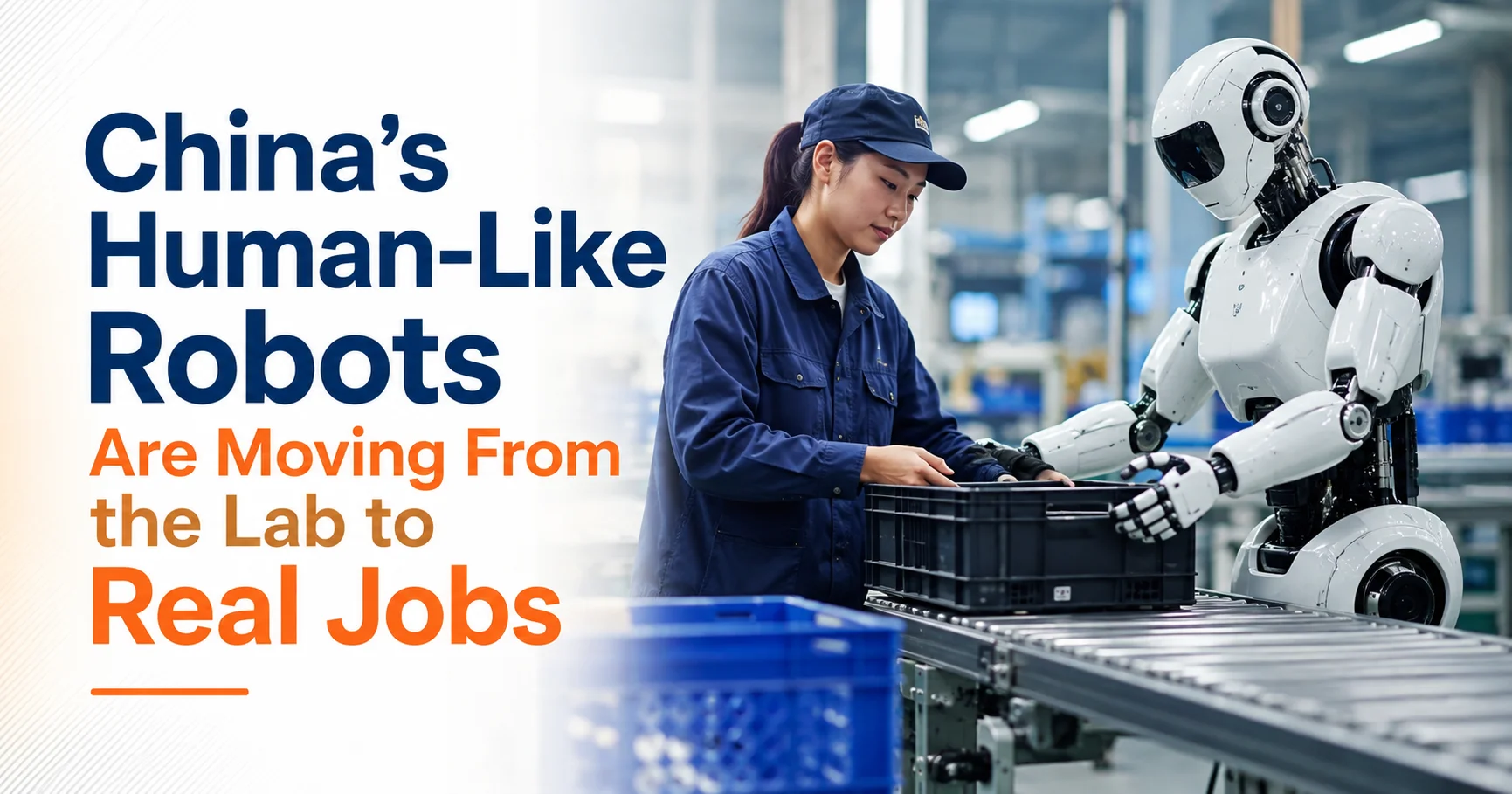
For years, humanoid robots were mostly seen in science-fiction movies, technology exhibitions and research laboratories. That is now beginning to change.
In China, human-like robots are moving into factories, warehouses and other workplaces, where they are being tested on tasks traditionally performed by human workers.
China is not alone in this race. The United States, Europe, Japan and South Korea are also developing humanoid robots. However, China has built a major advantage in manufacturing at scale and putting robots into real-world environments.
China Moves From Robot Shows to Real Work
China’s humanoid robotics industry has expanded rapidly. Companies including AgiBot, Unitree and UBTECH are developing robots for manufacturing, logistics, research and other commercial uses.
At the 2026 World Robot Conference in Beijing, Chinese companies demonstrated robots sorting parcels, packing mobile phones and performing other practical tasks. According to industry data cited in the original report, Chinese manufacturers accounted for more than 97% of roughly 19,100 humanoid robots shipped worldwide during the first half of 2026.
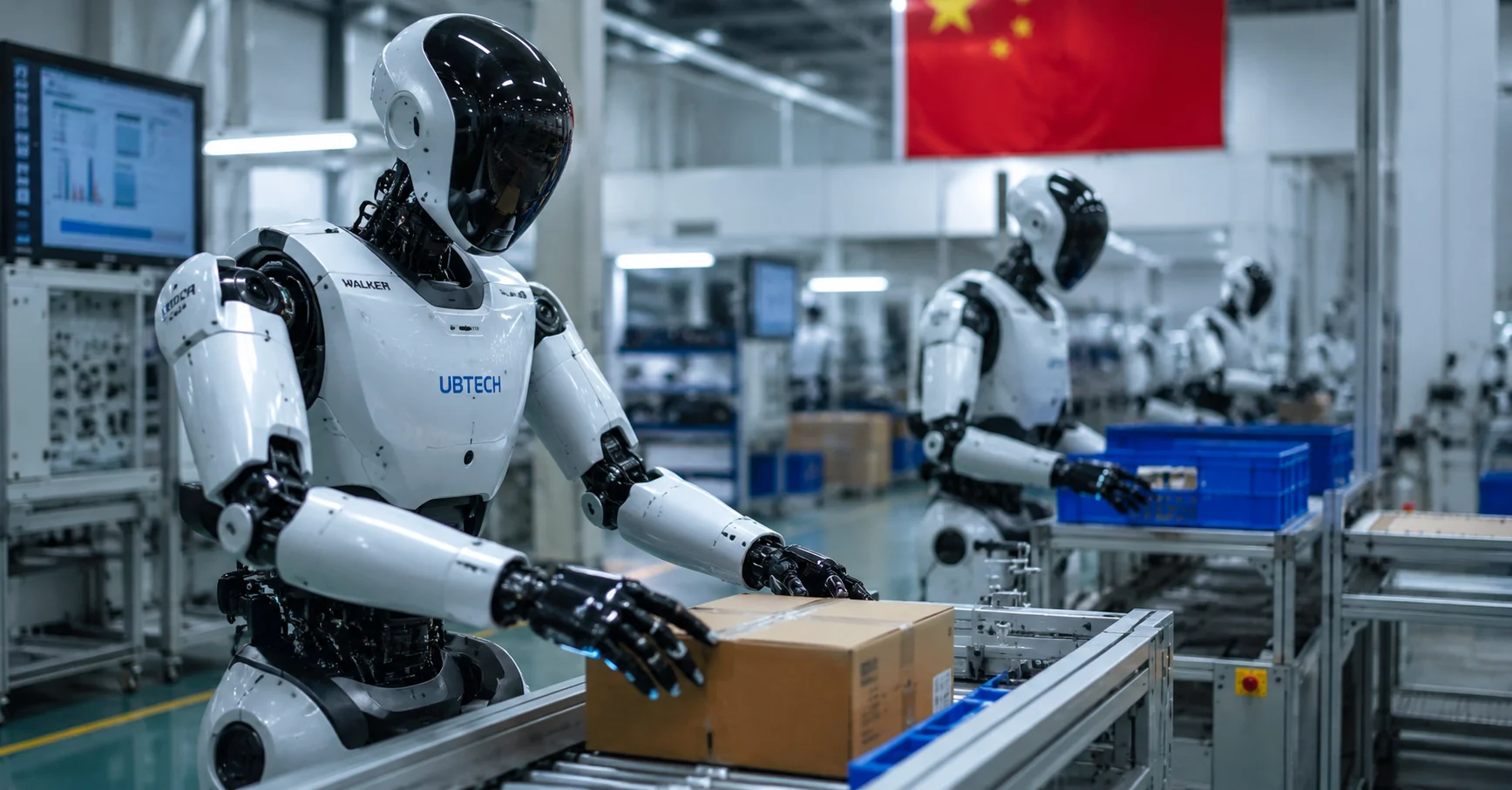
China’s advantage goes beyond production numbers. Its enormous manufacturing ecosystem allows companies to test robots in factories, improve them and then manufacture them in larger quantities.
AgiBot, for example, has deployed robots in manufacturing environments. One robot reportedly completed more than 140 hours of continuous operation on a consumer-electronics production line in Nanchang, with plans to expand the deployment to around 100 units.
Government support is another factor. China has introduced programs and policies aimed at accelerating humanoid robotics and “embodied AI,” giving domestic companies additional support as the industry develops.
The United States Is a Major Competitor
The United States remains one of China’s strongest competitors, particularly in artificial intelligence, software and advanced robotics.
Companies such as Figure AI, Agility Robotics and Tesla are developing humanoid robots for industrial and commercial applications.
Figure AI has already demonstrated its technology in a real manufacturing environment. At BMW’s plant in Spartanburg, South Carolina, Figure 02 operated for about 1,250 hours over an 11-month pilot, handling more than 90,000 parts and supporting production of more than 30,000 BMW X3 vehicles.
BMW has since introduced the next-generation Figure 03 robot in a logistics role at the same facility. Agility Robotics is also developing Digit for warehouse and logistics operations, with deployments involving companies such as GXO and Schaeffler.
This gives the United States a strong position in robotics software, AI and advanced humanoid systems, even though China currently has a much larger manufacturing base.
Europe, Japan and South Korea
Europe is developing its own humanoid robotics sector, with companies exploring uses in manufacturing, logistics, hospitality and agriculture. European firms also benefit from strong engineering and industrial automation expertise.
Japan remains a major robotics power, with decades of experience in industrial robots, precision manufacturing and machines designed to operate safely alongside people.
South Korea brings similar strengths, particularly in highly automated manufacturing, electronics, semiconductors and advanced components.
Neither country, however, can automatically translate its traditional industrial robotics expertise into leadership in general-purpose humanoid robots.
So, Who Is Winning?
There is no single winner yet.
China currently appears strongest in production volume, domestic deployment and manufacturing scale. More than 70% of Chinese humanoid robot shipments were reportedly going to industrial and commercial applications in the first half of 2026, suggesting that the technology is moving beyond demonstrations and into practical work.
The United States is particularly strong in AI, software, robotics research and ambitious commercial projects. Europe has advantages in engineering and specialized robotics, while Japan and South Korea bring extensive experience in automation and precision manufacturing.
China may currently have the biggest lead in getting humanoid robots into the market, but the global competition is far from over.
The Real Test: Can Robots Make Money?
The biggest challenge is no longer simply building a robot that can walk, run or perform an impressive demonstration.
The real test is whether a robot can work for hours, complete useful tasks safely, require limited supervision and save a business money.
Many humanoid robots, including those in China, are still being used in research, demonstrations and pilot projects. Impressive demonstrations do not necessarily mean the technology is ready to replace large numbers of human workers.
The real breakthrough will come when businesses can prove that a robot can perform a job better, cheaper or more safely than existing alternatives.
What This Means for Young People
The growth of humanoid robots could change the workplace, but it does not simply mean that robots will eliminate jobs.
New opportunities will emerge in areas such as robot design, programming, AI systems, hardware repair, deployment and workplace safety.
For young people, skills in programming, artificial intelligence, mathematics, electronics, mechanical engineering and robotics could become increasingly valuable.
The Race Has Only Just Begun
China has established itself as the most aggressive large-scale player in humanoid robotics, combining manufacturing capacity, government support and a huge domestic market.
But the United States has powerful AI and robotics companies. Europe has advanced engineering and specialized robotics firms, while Japan and South Korea have decades of experience in automation and precision manufacturing.
The next few years will determine whether China can turn its production advantage into lasting technological leadership or whether its competitors can close the gap.
One thing is already clear: humanoid robots are leaving the laboratory. They are entering factories, warehouses and other workplaces, and the competition to build the machines that will work alongside humans has only just begun.